Physics 101
What we did
today!
Tues.
Ap. 14
Ch. 26
Nuclear Power -- Alternate Energy, but NonRenewable
Basic
Ideas:
The
atom/nucleus: ~1895
- Becquerel discovers "radioactive" materials: namely uranium salts
- Gives Pierre and Marie Curie the job of isolating radioactive
materials
- They share the Nobel prize for discovery of radioactivity and
radium.
- Rutherford finds alpha and beta rays looking at "Becquerel rays"
- Villard finds gamma rays
Radioactive
Decay:
- Alpha particles are helium nuclei -- 2 protons and 2 neutrons
- Beta decay depends on an electron either
- being produced when a neutron turns into a proton and then an
electron must be spit out of the nucleus
- being absorbed, or captured, by a proton so that it turns into
a neutron
- Gamma decay is a photon with very high energy
- 100s of KeV or Mev in energy
- compared to xrays in the 10s to 100 KeV
- compared to visible light in the 0.5 - 2 eV
- 233Pa 91
has 91 protons, 142 neutrons, 91 electrons, and 233 nucleons.
Radioactive
Decay Equations:
- Number of nucleons is conserved
- Element may transform up or down the periodic table to a
different element depending on the number of protons remaining after
the decay
- Element may stay the same and just release energy from the
nucleus (gamma decay)
- Charge is conserved
Half-life
of Radioactive
Decay:
- The half-life of a radioactive material (one with unstable nuclei
in it) is defined as the time it takes for half of the radioactive
nuclei to decay to their decay products (called daughter or child
products).
- For instance, if the half-life of helium-8 is 0.119 seconds,
then if 50 grams of helium-8 decayed for 0.119 seconds, there would
only be 25 grams of helium-8 left and the rest would be made up of the
daughter material.
Nuclear
Fission:
- Nuclear fission is the splitting of a large nucleus into two
smaller nuclei with the release of neutrons and energy
- For a nuclear power plant, U-235 is struck by a neutron becoming
U-236. U-236 is unstable and undergoes fission. It can
break into a number of different daughter particles like: 1) Kr
and Ba, 2) Xe and Sr, or 3) Pd and Pd for example.
- The neutrons which are released go on to create more unstable
U-236 atoms for more fission to occur.
- The energy is used to heat water so it either turns to steam or
is just really hot water under pressure. This heated water then
turns a turbine (remember these) and makes a coiil rotate in a magnetic
field to GENERATE power !!
Ch. 26 Homework
Review: 13,15,17,18,20,21,26,27,35
Qs: 1,3,4,9,11,12,15,16,19,20
Problems: 1,2,6,8-10
Nuclear Power -
what's new and how
does it work?
Tues. Ap. 14
Generators,
cont. & Their Use in Alternate Energy
Basic
Articles to
Use for Greenhouse Effect & ALternate Energy
Non-Generator Alternate E Sources include:
Solar Cells
Hydrogen Fuel Cells Discussion
HOMEWORK
Ch. 17
Review: 25
Ch18
Review: 10,11,12
Problems: 1a, 7a, 7b
Ch. 25
Review: 3,6,7,12,13
Thurs. Ap. 9
Ch.
18, 17 & 25 -- Basic Circuits, Solids, & Generators
Electric Charge:
Charge” is a
fundamental property of matter.
There are two
types of electrical charges:
—positive
charge (+)
—negative
charge
(-)
From. Dr.
Burcin Bayram's Ch. 4 Lecture on E&M
Solid Materials which make up devices can be:
Conductors
Insulators
Semiconductors
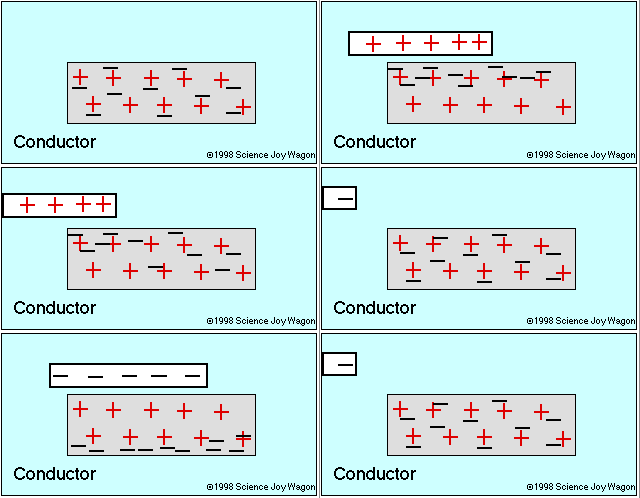
Conductors: Electrons are free to move in the material.
They are in the "conduction" band of the material.
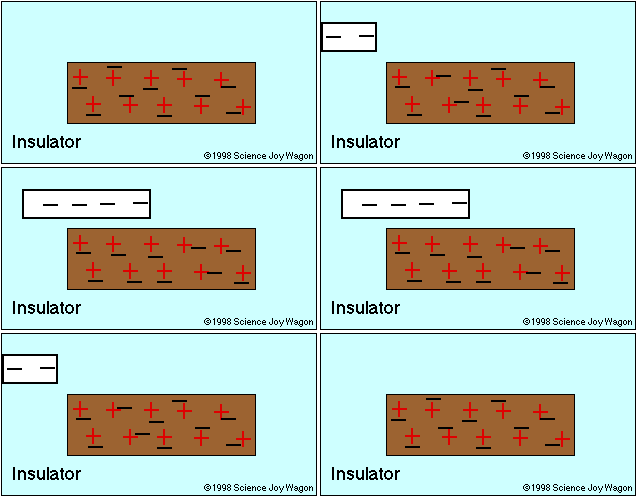
Insulators: Electrons are unable to move in the material except
around the nucleus of the atoms. They are in the "valence" band
of the material.
A simple circuit: An energy source, wires to connect
objects, a resistive device (lightbulb for example)
Current flows through the wires from the battery to the device, through
the device and back to the battery -- a complete circuit. Current
is the # of charges per unit time.
The rule which governs the flow of the electricity is called Ohm's
Law.
Voltage (V) = Current (I) x Resistance (R)
V = I R
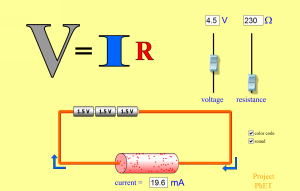
A
simple circuit: An energy source, wires to connect
objects, a resistive device (lightbulb for example)
Magnetism:
The region around a moving charge
creates a magnetic field, B.

We can plot the magnetic field lines
around a magnet with simple iron filings or a compass.
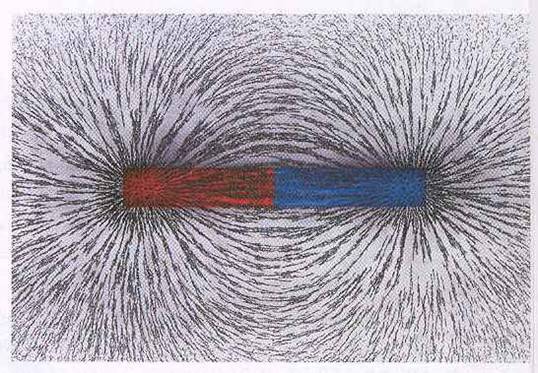
South
Pole
North Pole
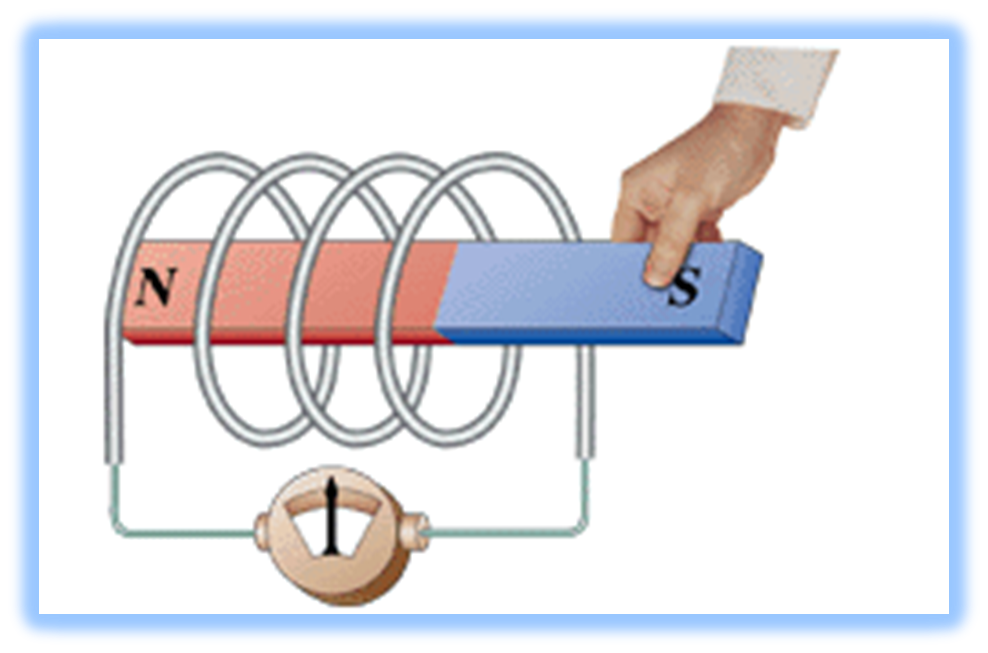
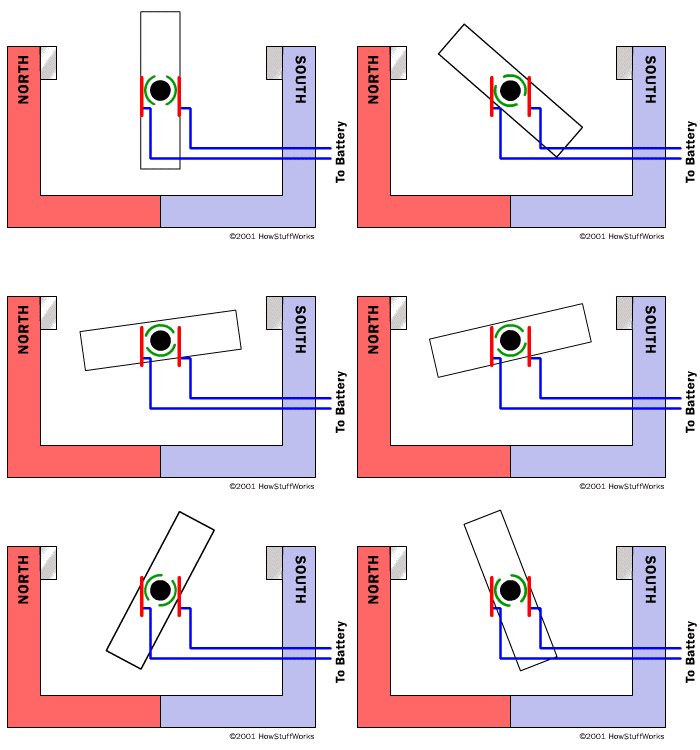
Electricity and Magnetism are Interdependent
A generator can
be formed using this valuable quality.
To Read for
Thursday, April 9th
Ch. 17 pp. 361-366
Ch. 18 pp. 374-382
Ch. 25 pp. 532-535
''Tues. April 7th
PBS "Global Warming: Solutions" DVD
Narrated by Erick Avari
Questions to Consider:
1. What different alternate energies
did the DVD explore
2. Pick one and explain it
3. What energy source was the most
surprising to you?
4. Which energy source is closest to
being used heavily in the US
5. Which energy source is furthest from
commercial use?
6. Which would probably be one of the
best if it can be scaled up?
Basic
Articles to
Use for Greenhouse Effect & ALternate Energy
Other
Helpful Articles/Cites
''Tues. Mar 17 & Thurs. Mar 19
Al Gore's "An Inconvenient Truth" DVD
An Inconvenient Truth: A
Global Warning
!
With Al Gore and www.ClimateCrisis.net
As you watch the movie, Keep track of the following:
1. Important physical/scientific facts provided
2. Important policy issues discussed
3. When Al Gore politicizes the DVD, are the ill-timed comments
on science, or policy, or just as part of the "talk" he is giving
4. Was his personal life story affecting in terms of the DVD's
goal?
DAY 1 of the Movie Group Discussion
1. List 5 important
points that were presented on the DVD, and explain them in one sentence
2. What was the most surprising thing you
learned from this presentation?
DAY 2 of the Movie
Group Discussion Paper
Second time, same as before:
1. List 5 important
points that were presented on the DVD, and explain them in one sentence
2. What was the most surprising thing you
learned from this presentation?
Tues. Sept. 30th
Second
Writing Assignment Grading
Rubric
THurs. Feb. 26 & Tues. Mar 3 & Thurs. Mar 5
Ch. 11: Thermal Energy & Greenhouse Effect
Thermal
Energy Examples à
Greenhouse Effect à
Global Warming
Any
calculations should include equations and show all work with units
1. If you were building a road of steel
reinforced concrete, what worries would you have about the effects of
temperature
variation with seasons? If a(concrete)
= 18 x 10-6/C and a (steel) = 12 x
10-6 /C, how different would the
expansion be for a steel rod 16 m long versus a 16 m long length of
concrete
from winter at 10C to summer at 40C?
2. In the winter, an Al metal signpost which is
30 m high will change its length by how much when the temperature drops
45C. a (aluminum) = 24
x 10-6/C
3. If you shake sugar, it will get
warmer. How much work would you have to
do to increase a 2Kg bag’s temperature by 3C if c(sugar) = 0.35 KJ/KgC?
4. If you were to weight lift strenuously for 30
minutes, raising a 30 kg bar over a distance of 0.5m each minute, how
much
would your 75 kg body’s temperature increase? c(body) = 0.85 kJ/kgC
5. Draw the earth and the atmosphere above
it. Then draw the sun.
Add the sun’s rays in such a way as to
illustrate the Greenhouse Effect and describe in a few phrases.
6. List what gases you think are partially
responsible for the Greenhouse Effect and Global Warming with sources
for them
if possible.
Website for Greenhouse Effect and Global Warming
http://science.howstuffworks.com/global-warming.htm
Main Ideas:
Thermal energy
All matter is composed of continually
jiggling atoms and molecules.
Thermal energy is a measure of the amount of energetic jostling of said
atoms and molecules.
Heat
Flow of thermal energy from one body to
another
Temperature
Quantity which describes how warm or cold
something is with respect to a standard (a thermometer). It is a
measure of the average KE of atoms and molecules comprising a body.
Phy101: Thermal Energy Experiments
Mechanical
Energy à Thermal Energy
Test
1: Use a rubber band from the kit. Put it on your top lip and feel how warm
it
is. Stretch it 20 times.
Put it back on your lip.
What
has changed?
<>Why?
Test
2: Use a hammer and nail and a board
(provided up front). Hammer a nail part
way into the board and then pull it out.
Describe
how the nail feel before/after and why.
Thermal Energy
Test
3: Name 3 energy transfer mechanisms
<>a.
b
c
Ask
for help if you cannot remember them.
Test
4: Describe why a floor tile in the
bathroom feels cold and why the fluffy rug feels warm – which heat
transfer
mechanism is responsible.
Test
5: Check out the 3 objects in your
bag: cotton ball, wood, and metal
cylinder. What do you conclude about
each and why?
Test
6: If you put your hand near your face
(without touching it), what do you feel?
Why? Which heat transfer
mechanism is responsible?
Test
7: In the TWO diagrams below, a) depict what happens to the air during a hot
day at the shore on the top one, b) depict what happens to the air
during the
night. Mark temperature changes in words
at various parts of the diagram and air flow with arrows.
Hint:
The earth is able to change temperature more easily than the
water.
Expansion and contraction of
materials due to thermal fluctuations
Lnew
= Lold ( 1 + a delta(T))
where a =
coefficient of thermal expansion for a particular material (in inverse
celcius)
delta (T) = change in temperature in celcius scale
Energy
Transfer Mechanisms: conduction, convection, and radiation
Conduction - transmission of energy due to
electron and molecular collisions, generally requires contact
Convection - transmission of energy via
currents - usually seen in fluids gases and liquids - actual physical
motion of substance occurs
Radiation -
energy transfer due to motion of electromagnetic waves which are
produced by vibrating electrons of a material
In-Class Experiment: (1) Conduction of Heat from Various Objects
& (2) Convection of Heat in Water -- two cases.
Work produces Changes in
thermal Energy
W = Q = m C delta(T)
where W is work, Q is thermal
energy added/subtracted, m is mass, delta(T) is the change in
temperature, and C is the coefficient of energy transfer for a
particular material
Laws of Thermodynamics
1st Law: energy can neither be created
nor destroyed, but only transformed from one form to another.
2nd
Law: Two bodies at different temperatures put together will come
to thermal equilibrium by flow of energy from higher to lower
temperature body until they equalize.
Entropy
Entropy is the measure of disorder in the
universe. An isolated system will either increase its entropy (or at
best keep it constant), while the entropy of the universe moves toward
a maximum. (This is another statement of the 2nd Law of Thermodynamics.)
Ch. 11 HOMEWORK
Qs 4,6,9,14,15,18,24
Ps 6,7
Extra Problems:
E1. How much heat (work) is
required to raise the temperature of 500 g of water from 20 oC
to 30 oC? C(water) = 4180 J/kgoC
E2. If a 100 kg wrecking
ball is dropped 25 m onto an aluminum roofed building 32 times, how
much would 1 kg of aluminum's temperature change afterward (asssuming
all the energy/work from the ball went into that 1 kg portion of roof)?
C(Al) = 903 J/kgoC
Thurs.
Feb.19th & Tues. FEb. 24th
Ch. 8 -- Energy
Main Ideas:
The unit of energy is the Joule, J, in the metric system.
A J = (k2 m2) / s2.
Interestingly, this is also the unit of Work.
Kinetic Energy
KE = 1/2 m v2
Is energy due to motion of an object. Any object in
motion
will
exhibit KE. It is a
scalar quantity NOT a vector quantity.
Potential Energy
PE = m g h
Is energy due to position above or below a reference height.
PE
can be negative if
work must be done on the object to move it to your reference height.
Conservation of
Energy
states that energy can neither be created nor
destroyed, it simply changes states (or types of energy).
<>Conservation of Mechanical Energy states that a system
that is
isolated can exhibit
conservation of mechanical energy. That is the total energy
of the system comes from the sum of PE and KE and as the system
evolves:
<>
KE + PE = Constant.
Examples of Conservation of Energy:
(1) A 1 kg pendulum swings from a starting position
of
50
cm above equilibrium. What is its speed at the bottom of its
swing?
(2) The same pendulum swings to 15 cm above
equilibrium.
What is its speed there?
Mini Experiment
Bouncing
Balls & Roller
Coaster
Experiments
1.
Bouncing Ball:
Ball, meter stick
a.
Choose a height to start from. hi =
b.
Drop ball.
c.
Record height ball returns to. hf =
d.
Calculate the following quantities: PE before, PE after, Speed ball hits ground
with.
e.
Is mechanical energy conserved
during fall? After return bounce? What happens to the energy of the ball?
f.
Choose another height to start from. Then calculate how fast the ball is moving
part of the way through the fall (for instance, drop ball from 75 cm
and see
how fast it is moving at 30 cm)
2.
Roller Coaster Problem: Loop-de-loop, car or ball, meter stick
<>a.
Make necessary measurements to
calculate the
following:
PE at top, Speed of car/ball at bottom, Speed of
car/ball at
top of loop
CH. 8 Homework
Qs 4,5,6,9,11
Ps 13,16
Tues. Feb. 10
Ch. 4 - Newton's Laws &
Review for Exam #1
Key Concepts:
Equations:
F =
ma Newton's
2nd Law of Motion
Focus in on Newton's
Laws:
1. First and Second Law: The NET force is the important
quantity. If there is a NET
force, there is an acceleration. If there is NO NET force, there
is no acceleration; BUT there can still be motion (constant speed
in straight line).
2. Examples of Places where net force must be considered:
Falling objects and air resistance.
Pushing objects across a surface and friction force.
Examples of Newton's Laws -- Net force and terminal velocity
Units of Force (N), Weight (N), Mass (kg)
Tues. Feb. 3 & Thurs Feb. 5
Ch. 3: Projectile
Motion
Key
Concepts:
Projectile
Motion:
Motion can be separated into its vertical and horizontal components.
Vertical
motion controlled by gravitational forces and any air resistance that
occurs.
An
object undergoing horizontal motion feels no unbalanced forces (once
thrown/shot
object is
released).
Equations of
motion can be chosen for each type of motion.
Vertical: dy = 1/2 a t2
Vfy = Viy ± at
Horizontal: dx = Vix t
When a ball is thrown up in the air, it experiences
vertical motion.
When a ball is rolled across a table, it experiences
horizontal motion.
When a ball is thrown across the room, it
experiences
BOTH vertical and
horizontal motion.
Galileo showed that we can look at each of the above motions separately.
Phy
101
Motion Problems
Extra
Credit Motion Problem from In-Class - Solutions
1. Your kid
Brother drops a coin into a wishing
well. After 2.078 seconds, you and he
hear the “plopping” sound as the coin hits the water.
How deep is the well?
<>The
speed of sound is 344 m/s at 20oC.
Article
Analysis Rubric
Possible Article Topics for
Papers
Jan.21
and Jan. 22
Ch. 2 & 3: Intro to
Physics & Society
Graphing:
Key Concepts:
Distance vs. Time Graph
Velocity vs. Time Graph
Acceleration vs. Time Graph
Reading Graphs & Creating Graphs
What does each type of graph look like for the following
situations:
Constant Motion
-- the distance increases with time (straight line with some slope, the
steepness of the line is related to the speed), the speed stays
the same regardless of time (straight horizontal line), the
acceleration is zero
Acceleration --
The distance
increases or decreases with time but the slope changes (as you speed up
the
slope increases, as you slow down the slope of the curve decreases)
thus
you see a curved line on distance graph, the speed incresases of
decreases with time in a linear fashion (straight line with some slope
corresponding to acceleration), the acceleration is a constant at all
times (straight horizontal line (non-zero, may be positive or
negative))
No Motion -- the
distance remains the same regardles of time (straight horizontal
liine), all other graphs are at zero (no speed and acceleration)
Changing Acceleration
-- all graphs are more complicated, distance changes with time
in a curved fashion and so does speed, accelearation is changing with
time (straight line at some angle)
Simple
Motion:
Mini-experiment In Class
Equipment: Meter sticks & stop watches
Using the above tools and the people in your group. Measure
the
following quantities.
a) Average speed of a person walking at constant pace.
b) Average acceleration of person starting from stop to a run.
c) Your response time when dropping a ruler between fingers
Experimental Procedure: Describe below how you would do
the
above 3 measurements.
How many trials would you do? Why?
Data: Record data below and show calculations of speed,
acceleration, and response time.
Analysis: Are the values you calculated reasonable? why
or why
not?
What are possible sources of error?
Looking back would you change your experiment in any way?
How?
Thurs.Jan. 15th
Investigating Aritcles -- What to
look for
How graphs
Add to your Understanding of the Article OR Reading Graphs:
National Geographic, Jan. 2009
Issue, p.154: "Green Habits"
Scientific American
Article, Sept.
2006 Issue: "A Plan to Keep Carbon in Check."
Scientific American
Article, Sept.
2006 Issue: "The Nuclear Option."
HOMEWORK
ASSIGNMENT
Ch. 1
Qs. 5,6
Ps. 3c,d, 4c,d
Ch. 2
Qs. 1, 3-5, 7, 9
Ps. 4, 5
Ch. 3
Qs 2,3,9,
10 (graph), 13, 14 (graph), 15, 16
Ps
2, 15, 17-19 (graph), 21, 22
Tues. Jan 13th
Science -- an intro
-- see websites listed below
Discussion about Physics
& Technology & Us
- Define physics
- What is technology?
- What is the difference between the two?
- How does society (YOU) interact with science/physics and
technology?
- WHat power/influence does society have on science and technology?
<>
Discussion
about Critical
Thinking
- What is critical thinking?
- How do YOU form an opinion?
- What is an informed opinion?
- How does one effectively argue a point?
Reading
Critically
- What are the facts
of the case?
- What are the
issues brought out in the study?
- Who is affected by
the problem (may or may not be persons directly mentioned in stories)?
- What are possible
directions one could take from where the story left off?
- What would be the
possible consequences of such actions?
- Ethical, social,
economic, and political implications
- Practical
constraints
Small
Group Discussion
Please
meet in your groups and answer the following questions.
1.
Describe the Greenhouse effect
2. What are the most important issues surrounding it?
3. What questions do you have about the Greenhouse effect?
4. Describe Alternate energy
5. What issues are there about it?
6. What questions about alternate energy do you have?
7. Describe Nanotechnology
8. What important issues surround nanotechnology?
9. What questions do you have about it?
READING
ASSIGNMENT:
Read CH.
1 & 2 in Textbook